





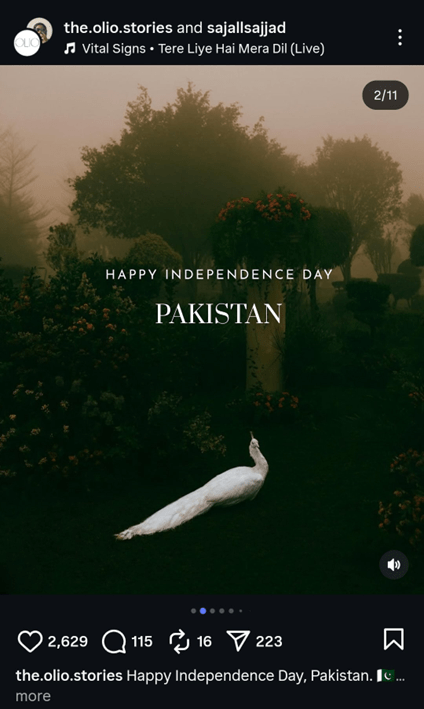
 When it comes to India, there are few things as sacred as the tricolour and the map that defines our sovereignty. Yet, now and then, a brand crosses a line so sharp it ignites collective outrage. This Independence Day, that line was crossed by The Olio Stories, a Delhi-based jewellery brand that released a campaign featuring a distorted map of India omitting Jammu & Kashmir and Ladakh. To add fuel to the fire, the campaign also included an Independence Day greeting for Pakistan.
The Error That Wasn’t Small
In India, a map is never just a map. It is a living reminder of centuries of struggle, sacrifice, and resilience against forces that have sought to fracture the nation. To the outside world, a missing border or a blurred outline may look like an innocent oversight. But to us Indians, every line carries the weight of history and blood.
The omission of Jammu & Kashmir and Ladakh from The Olio Stories’ campaign was not a design error; it was a wound, reopened. These territories are not abstract spaces on paper; they are landscapes where soldiers patrol under hostile conditions, where families have lost sons and daughters, and where the tricolour has flown defiantly against all odds. Each valley and mountain stands as testimony to lives laid down in defence of sovereignty.
By erasing them from the map, however unintentionally, the brand did more than misplace a border. It appeared to dismiss the decades of sacrifice at Kargil, the long insurgencies battled in Kashmir, and the constant vigilance that defines India’s northern frontier. For millions of Indians who see the map as sacred, the image was not just inaccurate it was an affront to the very idea of India.
In a country where national pride is non-negotiable, even the faintest distortion feels like a strike at the heart of unity. And once that trust is broken, no apology can redraw the line of faith.
A Pattern of Disrespect?
Twitter once sparked outrage by depicting Jammu & Kashmir as a separate country, prompting nationwide protests and even parliamentary discussions. International corporations like Amazon and clothing retailer Shein have faced boycotts for selling products that excluded parts of India. Even foreign governments have fumbled: Israel’s IDF, in an official post, once circulated a map that omitted Ladakh, drawing sharp diplomatic pushback.
Each of these “mistakes” might be brushed off elsewhere as a cartographic oversight. But for Indians, they reopen wounds tied to wars, insurgencies, and decades-long battles to keep the tricolour flying over every inch of sovereign soil. These are not abstract boundaries; they are lived realities defended in Siachen’s ice fields, remembered in Kargil’s martyrs, and prayed for by families whose children stand guard at the borders.
What makes The Olio Stories episode sting more deeply is that the error was homegrown. This was not a foreign platform or distant government, but an Indian fashion label claiming to celebrate “Azadi”. To invoke freedom while erasing a part of the motherland is more than tone-deaf; it feels like betrayal. When the lapse comes from within, the cut is sharper, the outrage more visceral. It raises an unsettling question: if those profiting from India’s markets cannot respect her full form, what exactly are they celebrating?
Public Outrage, Corporate Apology
The backlash was swift. Across Twitter and Instagram, users called The Olio Stories “traitors,” vowing to boycott the brand. Facing mounting criticism, the founders issued an apology, stating: “It was never our intention to hurt sentiments, and we are truly sorry.” But in the court of public opinion, apologies rarely erase perceived betrayal.
National Pride Is Non-Negotiable
The Olio controversy serves as a reminder to brands that in India, patriotism is not a theme you can experiment with casually. Our map is not a marketing prop. It is a sacred symbol of unity, identity, and sacrifice.
If there’s a lesson for brands here, it is simple: tread carefully with national symbols. Because when you distort India’s borders, you don’t just lose sales, you lose trust, respect, and a place in the hearts of Indians.
Opinion By: Sushrut Tewari,
a writer covering trends, innovation, and brand storytelling in India and beyond.